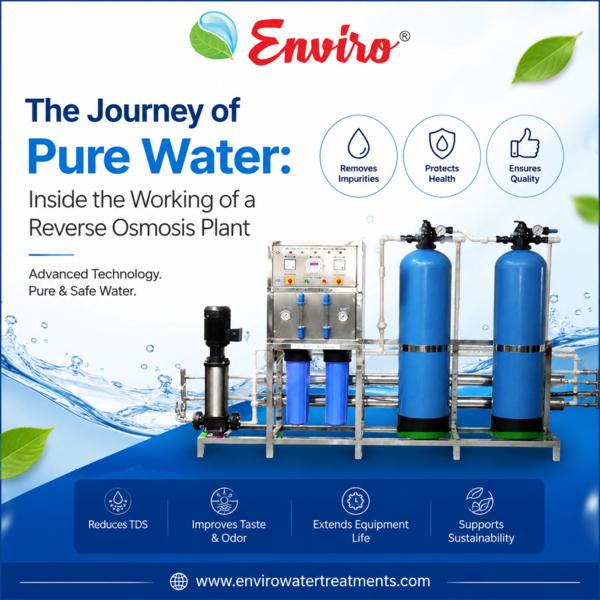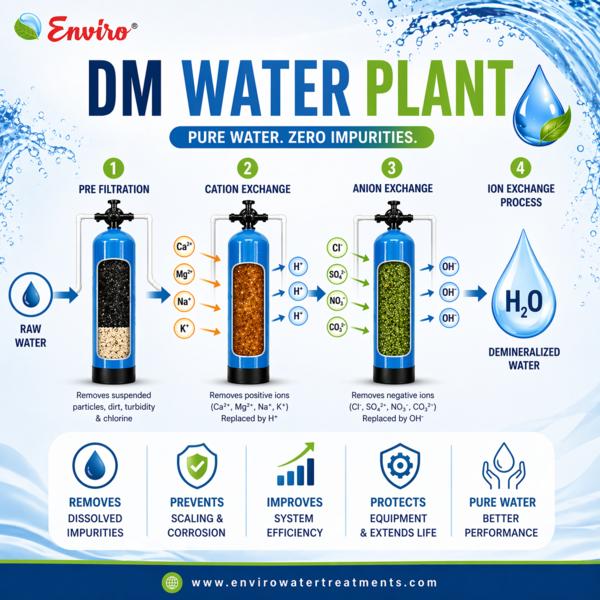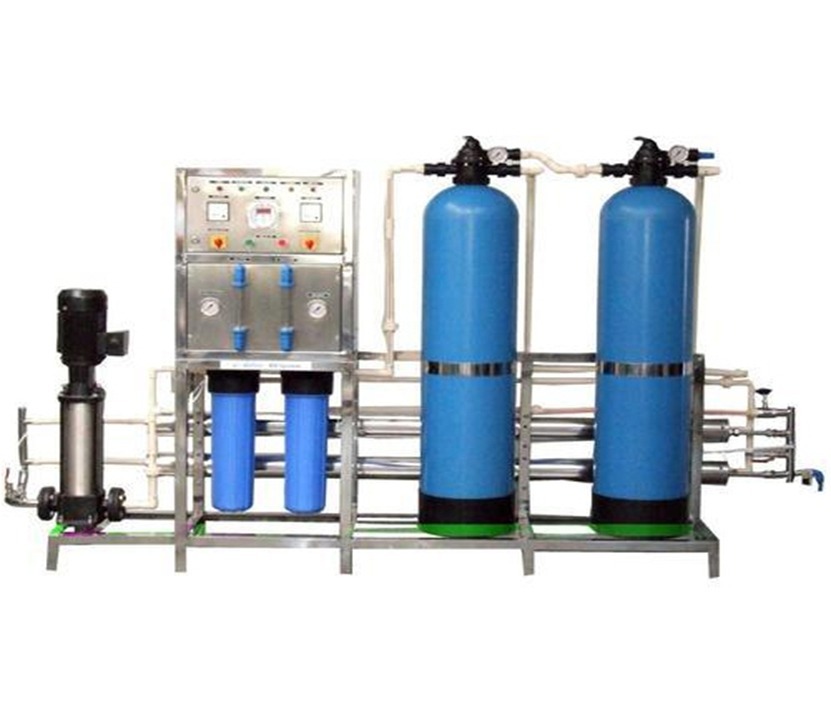
Reverse Osmosis Plants/RO Plants
The process of driving a solvent through a membrane from an area of high solid concentration to an area of low solute concentration by exerting a force greater than the osmotic pressure is known as reverse osmosis. This is the opposite of the typical osmosis process, which occurs naturally when no external force is applied and the solvent moves through a membrane from a region with low solute industry to one with high solid industry. Since this membrane is prior, solvent flow is permitted but solute transport is not.
This membrane is semipermeable, which means that solvents can travel through it but solutes cannot. Consider a semi-permeable membrane with concentrated aqueous solution on one margin and fresh water on the other to provide an example. Fresh water will come into contact with the membrane to dilute the concentrated solution if normal osmosis occurs. In reverse osmosis, the water molecules are forced across the membrane to the fresh water side by applying pressure to the side containing the concentrated solution. Severance occurs in the thick polymer barrier layer of the membranes used in reverse osmosis systems. Applying pressure to the high-solids water in the structure to force it through the membrane is necessary because reverse osmosis does not occur naturally. Pressures range from 8 to 14 bar for fresh and brackish water and 40 to 70 bar for seawater, which has a natural osmotic pressure of over 24 bar (350 psi) that needs to be controlled.
How does a Reverse Osmosis/RO Plant work?
The reverse osmosis principle underlies the operation of a RO plant, also known as a reverse osmosis plant. The process of physical separation is used in reverse osmosis, or RO, to remove molten solids from water. High-pressure raw water must pass through a semi-permeable membrane in order for impurities to be separated from the water and pure water to remain. Pre-filters and post-filters are also used by RO plants to treat water that has been adulterated.
Importance of Reverse Osmosis/RO Plant
The
importance of RO
Plants for
clear and healthy drinking water is very. Using a RO will be beneficial in the
following ways.
• No need to spend more money for getting safe
drinking water.
• Its hassle-free
installation and gives the riskless of managing any malfunction on your own
• It completely removes
the bacteria from the water making it fresh to drink.
Usage of Reverse Osmosis/ RO Plants
For their goods, industrial sectors such as the food, textile, and pharmaceutical industries require pure water. Excess chemicals that are dangerous to both people and machinery are separated by the RO plant. It benefits both domestically and commercially.
• filters water at a larger scale.
• keep water TDS as
per regulations.
• Help out in the
removal of chemicals dissolved in water.
• Lower the chances
of waterborne disease.
• Improve the water
reusability by purifying wastewater.
Benefits of Reverse Osmosis Plant/ RO Plants
Some of the benefits of RO Water Plant are followed below -
• A RO Plant separates contaminants that can cause water-related
disease.
•
A RO Plant involves the essential minerals absent in water.
•
A RO Plant Produce safe drinking water.
• It
also sweetness the taste and improves the smell of the water.
•
Removes chemicals and separates heavy
metals.