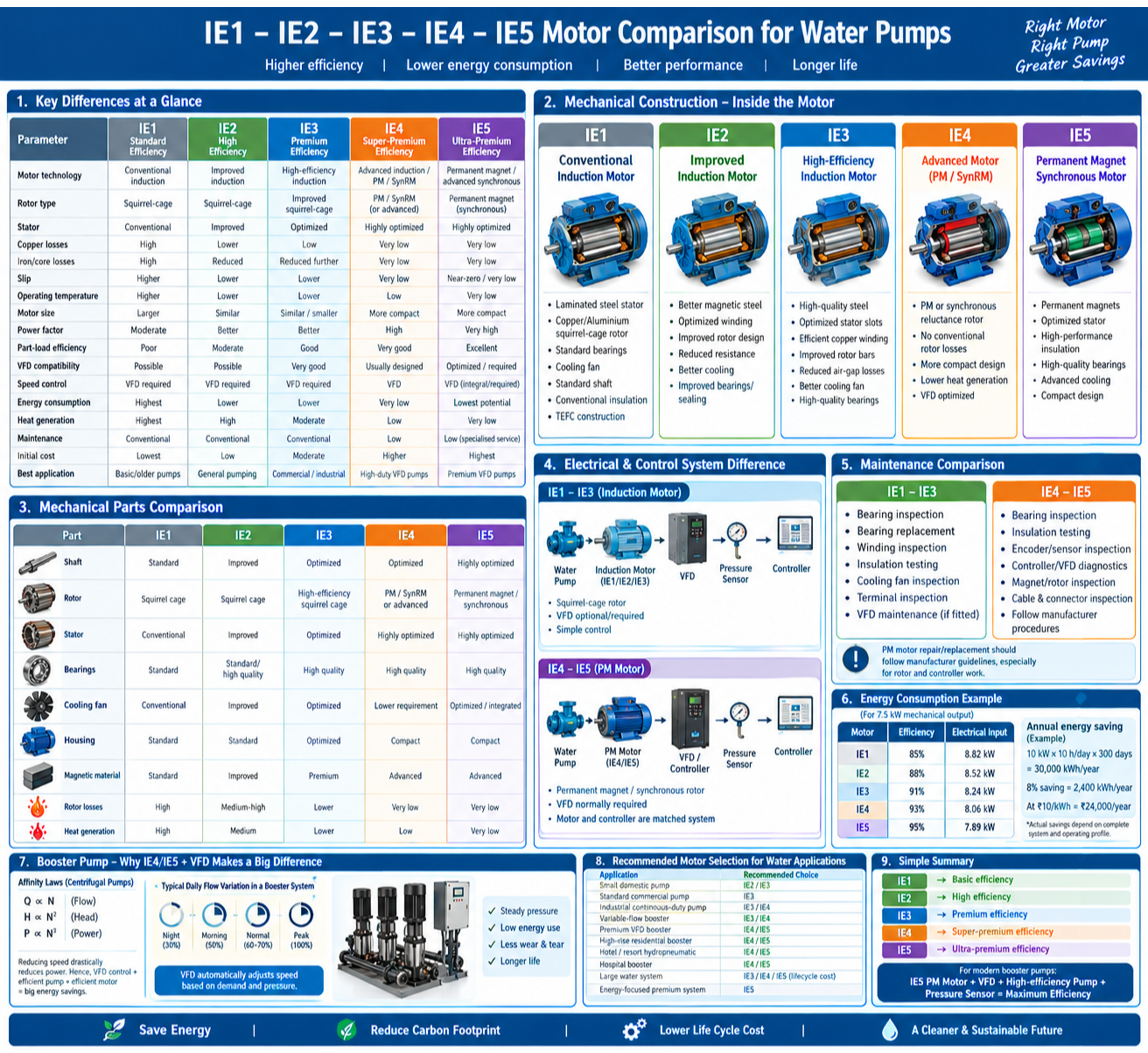
Below is a practical water-pump-focused comparison of IE1, IE2, IE3, IE4 and IE5 motors, covering electrical performance, mechanical construction, controls, maintenance and typical pumping applications.
Mechanical Construction Differences
IE1 Motor
Typical construction:
Conventional laminated steel stator
Copper/aluminium squirrel-cage rotor
Standard bearings
Conventional cooling fan
Standard shaft
Standard insulation system
Usually TEFC construction for water-pump applications
Mechanical characteristics:
More heat is generated because of higher losses.
Larger cooling requirement.
Higher operating temperature can increase bearing and winding stress.
Conventional construction makes servicing relatively straightforward.
Typical use: basic pumps where purchase price is more important than lifetime energy consumption.
IE2 Motor
IE2 generally uses an improved version of the conventional induction-motor construction.
Typical improvements include:
Better magnetic steel
Optimized stator winding
Improved rotor design
Reduced electrical resistance
Improved cooling
Better bearings/sealing depending on manufacturer
The basic mechanical concept remains a squirrel-cage induction motor.
IE3 Motor
IE3 takes the induction-motor concept further.
Typical construction includes:
Higher-quality electrical steel
Optimized stator slots
More efficient copper winding
Improved rotor-bar design
Reduced air-gap losses
Improved cooling fan
Better bearing arrangement
Lower internal losses
For a conventional centrifugal water pump, an IE3 motor is a common premium-efficiency choice.
IE4 Motor
IE4 is where motor construction can start becoming substantially different depending on the manufacturer.
IE4 can be achieved using advanced induction-motor designs, but many modern IE4 solutions use:
Permanent Magnet (PM) motors
Synchronous reluctance motors
PM-assisted synchronous reluctance motors
Other advanced synchronous motor technologies
Mechanical advantages
Compared with a conventional induction motor, an IE4 PM motor can have:
No conventional squirrel-cage rotor losses
Lower rotor heating
Compact rotor
Lower operating temperature
High efficiency at variable load
Good efficiency at reduced speed
This is particularly useful for VFD-controlled booster pumps.
3. IE5 Motor
IE5 represents the highest efficiency class in the IE classification system.
In practical water-pumping applications, IE5 motors are commonly associated with advanced permanent-magnet or other high-efficiency synchronous technologies.
A typical IE5 PM motor may contain:
Stator
Laminated electrical-steel core
Optimized slots
High-quality copper winding
High-performance insulation
Optimized electromagnetic design
Rotor
Instead of a conventional squirrel-cage rotor:
Permanent magnets are incorporated into the rotor.
The rotor produces its magnetic field without requiring conventional rotor current.
Rotor electrical losses can therefore be significantly reduced.
Bearings
Usually:
High-quality ball bearings
Carefully selected bearing life
Proper lubrication
Sealing appropriate to the pump environment
Cooling
Depending on design:
Fan cooled
Surface cooled
Integrated cooling
Special VFD/PM motor cooling arrangement
Electrical Difference
The basic relationship is:
Motor efficiency = Mechanical output ÷ Electrical input
For example, suppose a pump requires 7.5 kW mechanical power.
If the motor operates at:
IE1 = 85%
IE2 = 88%
IE3 = 91%
IE4 = 93%
IE5 = 95%
CRYSTAL GREEN INDIA
#Q-139, 7th main Road Hebbal Industrial Area Mysore- 570016
#69 Railway Parallel Road Kengeri Satellite Town Bangalore - 560060
India. Ph: +080-79667522 / +0821-4192770, Helpline: +91- 70222 15556.
Email: info@envirowsu.com Website: https://www.envirowsu.com
Follow Us: Facebook | Twitter | Instagram | YouTube