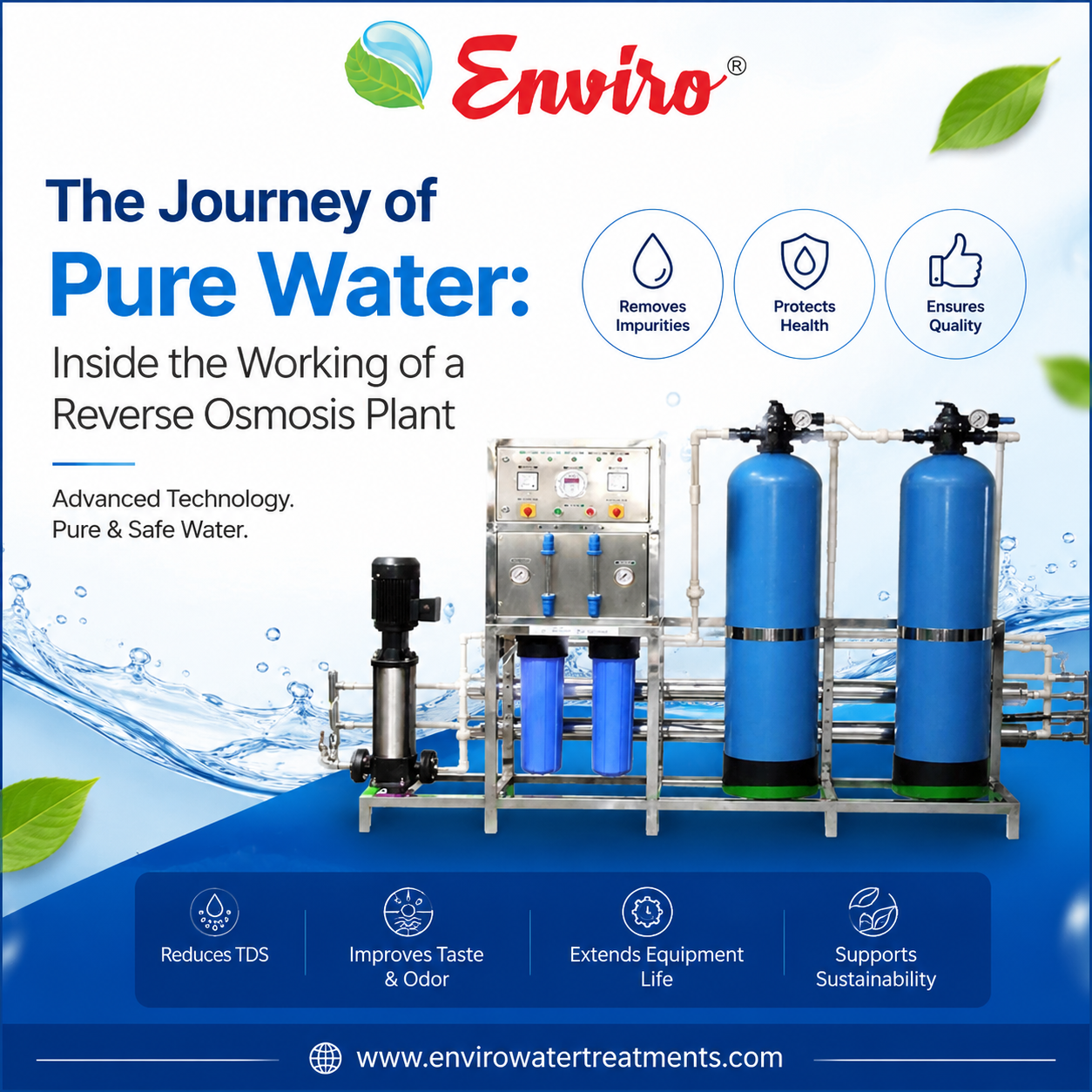
The Journey of Pure Water: Inside the Working of a Reverse Osmosis Plant
Water is one of the most essential resources for life, industry, and everyday activities. However, the water available from natural sources often contains dissolved salts, minerals, microorganisms, and other contaminants that make it unsuitable for direct use. Reverse Osmosis (RO) technology has become one of the most effective and widely used methods for producing clean, safe, and high-quality water.
In this blog, we take a closer look at the journey of water through a Reverse Osmosis Plant and explore how this advanced purification process transforms raw water into pure water.
What is a Reverse Osmosis Plant?
A Reverse Osmosis (RO) Plant is a water treatment system that uses a semi-permeable membrane to remove dissolved impurities, salts, bacteria, viruses, and other contaminants from water. By applying pressure, water is forced through the membrane, allowing only clean water molecules to pass while rejecting unwanted substances.
RO plants are widely used in residential, commercial, and industrial applications where high-quality water is required.
Why is RO Water Treatment Important?
Water from borewells, rivers, lakes, and municipal supplies often contains contaminants that can affect health, equipment performance, and industrial processes. Reverse Osmosis treatment helps:
Remove dissolved salts and minerals
Reduce Total Dissolved Solids (TDS)
Eliminate harmful microorganisms
Improve taste, odor, and clarity
Protect industrial equipment from scaling and corrosion
Ensure compliance with water quality standards
The Journey of Water Through an RO Plant
1. Raw Water Collection
The purification process begins with the collection of raw water from a source such as:
Borewell water
Municipal water supply
Surface water sources
Industrial process water
The quality of incoming water determines the treatment requirements of the RO system.
2. Pre-Treatment Process
Before water reaches the RO membrane, it undergoes pre-treatment to remove impurities that could damage the membrane or reduce system efficiency.
Multi-Grade Sand Filter (MGF)
The sand filter removes:
Suspended solids
Sand particles
Silt
Turbidity
This step improves water clarity and protects downstream equipment.
Activated Carbon Filter (ACF)
The activated carbon filter removes:
Chlorine
Organic compounds
Unpleasant taste and odor
Residual chemicals
Since chlorine can damage RO membranes, this stage is essential for membrane protection.
Water Softener (If Required)
Hard water contains calcium and magnesium ions that can cause scaling on RO membranes. A water softener reduces hardness and extends membrane life.
3. Micron Cartridge Filtration
The water then passes through cartridge filters, typically ranging from 1 to 10 microns.
These filters remove:
Fine suspended particles
Dust
Sediment
Remaining impurities
This provides an additional layer of protection before water enters the RO system.
4. High-Pressure Pump
Reverse Osmosis requires pressure to force water through the semi-permeable membrane.
The high-pressure pump:
Increases water pressure
Ensures consistent flow
Enables effective separation of contaminants
This stage is the driving force behind the RO process.
5. Reverse Osmosis Membrane Filtration
This is the heart of the RO plant.
The semi-permeable membrane allows water molecules to pass while rejecting:
Dissolved salts
Heavy metals
Bacteria
Viruses
Organic contaminants
Chemical impurities
The membrane separates water into two streams:
Permeate Water
This is the purified water that passes through the membrane.
Reject Water
This stream contains concentrated impurities that are removed from the system.
The RO membrane can remove up to 95–99% of dissolved contaminants, depending on water quality and system design.
6. Post-Treatment and Storage
After RO treatment, purified water may undergo additional polishing processes depending on application requirements.
These may include:
UV disinfection
Ozonation
Mineral dosing
pH adjustment
The treated water is then stored in a clean water storage tank for distribution or use.
Applications of RO Plants
Reverse Osmosis Plants are widely used across various sectors, including:
Industrial Applications
Manufacturing industries
Boiler feed water treatment
Cooling tower makeup water
Pharmaceutical production
Commercial Applications
Hotels
Hospitals
Educational institutions
Office complexes
Residential Applications
Apartments
Gated communities
Domestic drinking water systems
Food and Beverage Industry
Beverage production
Food processing
Bottled water manufacturing
Benefits of Reverse Osmosis Water Treatment
Superior Water Quality
RO systems effectively remove dissolved impurities and produce high-quality water.
Improved Equipment Life
Reduced scaling and corrosion help protect pipes, boilers, and industrial machinery.
Cost Savings
Lower maintenance costs and reduced equipment downtime contribute to long-term savings.
Reliable Performance
RO plants provide consistent water quality even when source water conditions vary.
Environmental Sustainability
Modern RO systems support water conservation and efficient resource utilization.
Maintaining an RO Plant for Optimal Performance
Regular maintenance is essential to ensure efficient operation and long membrane life.
Key maintenance activities include:
Periodic filter replacement
Membrane cleaning
Monitoring operating pressure
Water quality testing
Routine system inspections
Proper maintenance helps maximize efficiency and reduce operating costs.
Conclusion
Reverse Osmosis technology plays a vital role in delivering clean, safe, and reliable water for residential, commercial, and industrial applications. From raw water intake to advanced membrane filtration, every stage of the RO process contributes to producing water that meets the highest quality standards.
Understanding the journey of water through an RO Plant highlights the importance of each treatment stage and demonstrates how advanced purification technology transforms raw water into a valuable resource. As water quality challenges continue to grow, Reverse Osmosis remains one of the most trusted and effective solutions for ensuring a sustainable supply of pure water.
Enviro Water Treatments specializes in designing and delivering advanced RO Water Treatment Solutions tailored to diverse industrial, commercial, and residential requirements, helping organizations achieve superior water quality and operational efficiency.