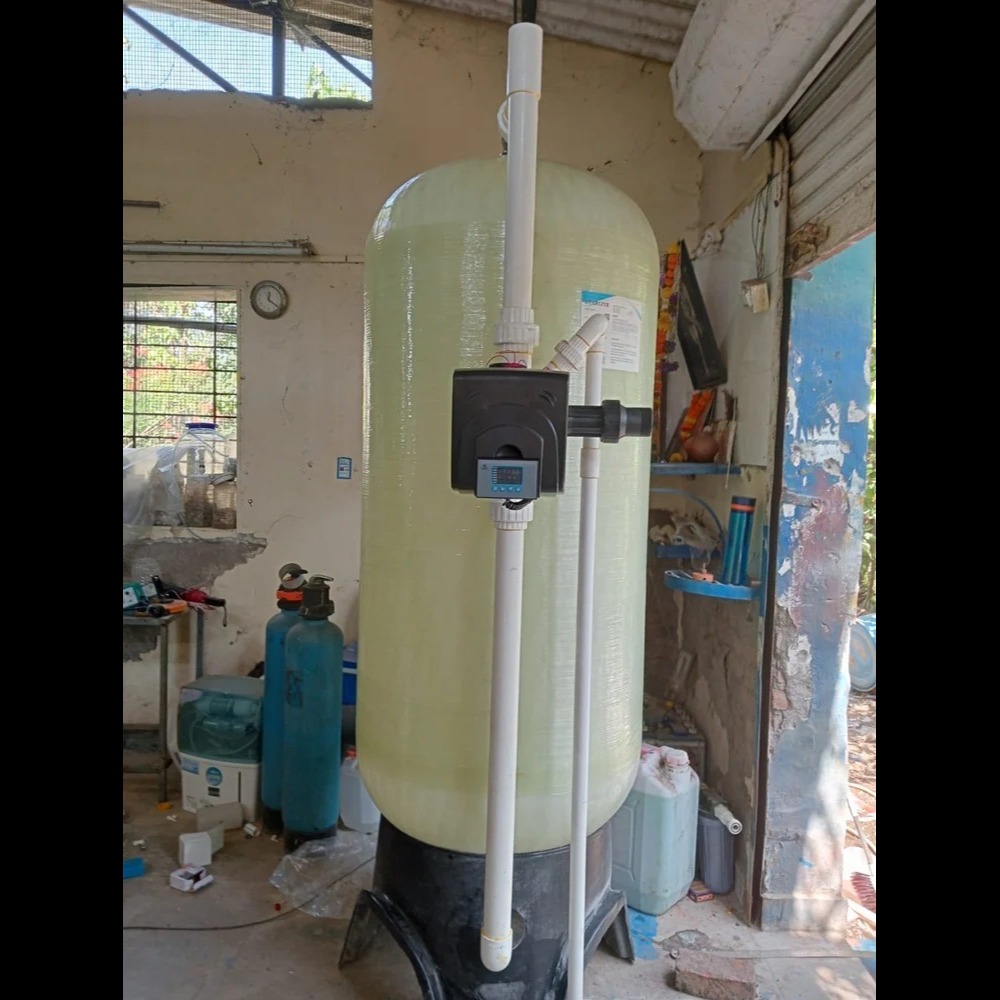
Demineralization (DM) water Treatment Plants
Demineralization is the process of removing mineral
salts from water by using the ion exchange process.
Demineralized Water is Water completely free (or
almost) od dissolved minerals as a result of one of the following processes:
·
Distillation
·
Deionization
·
Electrodyalisis
·
Membrane filtration (reverse osmosis or
nanofiltration)
·
Or other technologies
Demineralized Water also known as Deionized Water, Water
that has had its mineral ions removed. Mineral ions such as cations of sodium,
calcium, iron, copper, etc and anions such as chloride, sulphate, nitrate, etc
are common ions present in water. Deionization is a physical process which uses
specially-manufactured ions exchange resins which provides ion exchange site
for the replacement of the mineral salts in water with water forming H+ and
OH-ions Because the majority of water impurities are dissolved salts,
deionization produces a high purity water that is generally similar to
distilled water, and this process is quick and without scale buildup.
De-mineralization technology is the proven process for treatment of water. A DM
water system produces mineral free water by operating on the principles of ion
exchange, Degasification, and polishing. Demineralized water system finds wide
application in the field of steam, power, process, and cooling.
Through a variety of
procedures, demineralization (DM) water treatment facilities eliminate salts
and minerals from water, creating high-purity water suitable for industrial
uses.
How Demineralized (DM) Water Plants Work:
Raw Water
Intake: Natural water sources include lakes, rivers, and subterranean wells.
Pretreatment: By means of
sedimentation, filtration, and disinfection, suspended particles, organic materials,
and contaminants are eliminated.
Ion
Exchange: Ions like calcium, magnesium, and chloride that have dissolved in the
water are eliminated using ion exchange resins.
Regeneration: Chemicals such as
hydrochloric acid or sodium chloride are used to renew ion exchange resins in
order to restore their efficacy.
Polishing: Ultra-pure water can
be obtained by additional processes like reverse osmosis or ultrafiltration.
Types of
Demineralized (DM)Water Plants:
Ion
Exchange-based Plants: To eliminate ions and create water with a conductivity of less than 30
cm, use resins.
Membrane-based
Plants: To create high-purity water, use mixed bed ion exchange and reverse
osmosis.
Electro Deionisation
(EDI) Plants: To create water with a conductivity of less than 0.5 μmhos/cm, use RO and
EDI.
Applications of DM Water Plants:
Laboratories: For accurate testing
and equipment upkeep.
Automotive
Industry: To keep car systems from corroding and scaling.
Pharmaceutical
Manufacturing: For manufacturing pharmaceuticals of superior quality.
Electronics: For avoiding
corrosion and cleaning circuit boards.
Power
Plants: For the production of steam and boiler feed water
Benefits of
DM Water Plants:
High-purity
water: Ideal for a range of industrial uses.
Corrosion
prevention: Minimizes corrosion and scaling in pipelines and equipment.
Improved
product quality: Vital for laboratory, electronics, and pharmaceutical applications.
Energy
efficiency: Can be made to be both ecologically friendly and energy-efficient