Water quality varies depending on its source. Some water contains excess minerals that cause scaling, while other sources have high levels of dissolved salts and impurities. These problems can affect household plumbing, commercial equipment and industrial operations.
Water Softeners and Reverse Osmosis (RO) Plants are two commonly used water treatment systems. Although both improve water quality, they work differently and are designed for different purposes. Understanding their differences helps you select the right system for your requirements.
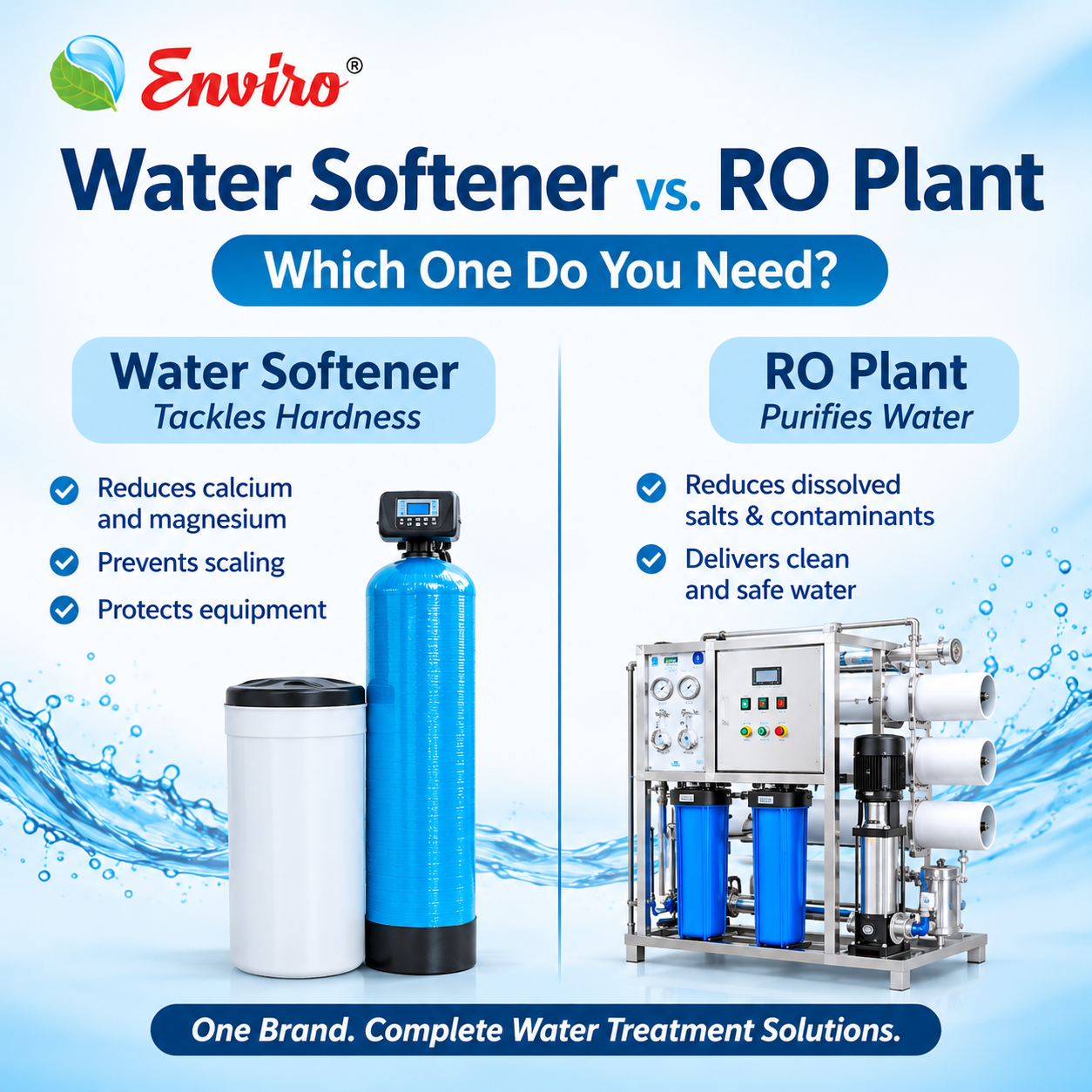
What Is a Water Softener?
Hard water contains dissolved minerals, mainly calcium and magnesium. These minerals can accumulate inside pipelines, water heaters and bathroom fittings, creating stubborn white deposits and reducing equipment efficiency.
A water softener reduces hardness through a process called ion exchange. Water passes through a special resin bed that captures calcium and magnesium ions and replaces them with sodium ions. The resin is periodically regenerated using a salt solution to restore its softening capacity. Water softeners are commonly used in homes, apartments, hotels, hospitals, laundries and industries where hardness-related scaling needs to be controlled.
What Is an RO Plant?
A Reverse Osmosis (RO) plant is designed to reduce dissolved salts and various other contaminants present in water.
It uses a semipermeable membrane that allows water molecules to pass through while rejecting a large proportion of dissolved salts and other substances. The treated water is collected separately, while the concentrated reject water is discharged. RO plants are widely used for drinking water purification, commercial establishments, food processing and industrial applications where specific water quality requirements must be achieved.
Water Softener vs. RO Plant: Key Differences
Parameter Water Softener RO Plant
Main purpose Reduces hardness Reduces dissolved salts and contaminants
Technology Ion exchange Reverse osmosis
Targets Calcium and magnesium Dissolved salts and various contaminants
TDS reduction Generally no significant reduction Significantly reduces TDS
Salt requirement Required for regeneration Not normally required
Maintenance Salt replenishment and resin servicing Filter and membrane maintenance
Main applications Scale prevention Water purification
An important difference is their effect on TDS. A water softener exchanges calcium and magnesium with sodium, so it generally does not significantly reduce overall TDS. An RO plant, however, can reduce TDS considerably depending on feedwater quality and membrane performance.
Can Both Systems Be Used Together?
Yes. In many commercial and industrial installations, water softeners and RO plants are used together.
For example, groundwater with high hardness can cause scaling on RO membranes. Installing a suitable water softener before the RO plant helps reduce hardness and control the risk of membrane scaling.
A typical treatment arrangement is:
Raw Water → Pressure Sand Filter → Activated Carbon Filter → Water Softener → Cartridge Filter → RO Plant → Treated Water Storage
The actual arrangement depends on raw water quality. Additional pretreatment may be necessary depending on iron, silica, organic matter and other parameters.
Which System Should You Choose?
The right system depends on the water quality problem you need to address.
Choose a Water Softener if:
• Your water contains high calcium and magnesium hardness.
• You notice white deposits on taps and bathroom fittings.
• Your water heaters, boilers or pipelines experience scaling.
• You want to reduce hardness-related equipment maintenance.
Choose an RO Plant if:
• Your water has high TDS.
• You need to reduce dissolved salts and other contaminants.
• You require purified water for drinking or industrial processes.
• Your application has specific treated water quality requirements.
If your water has both high hardness and high TDS, a combination of the two systems may be appropriate.
Choose the Right Water Treatment Solution
A water softener and an RO plant are not interchangeable. A softener helps control hardness and prevent scaling, while an RO plant reduces dissolved salts and a wider range of contaminants.
Selecting the right technology begins with understanding your water quality. Proper system selection and installation can improve water management, protect equipment and reduce long-term maintenance requirements.
Crystal Green India – Complete Water Treatment Solutions
We provide residential, commercial and industrial water treatment solutions.