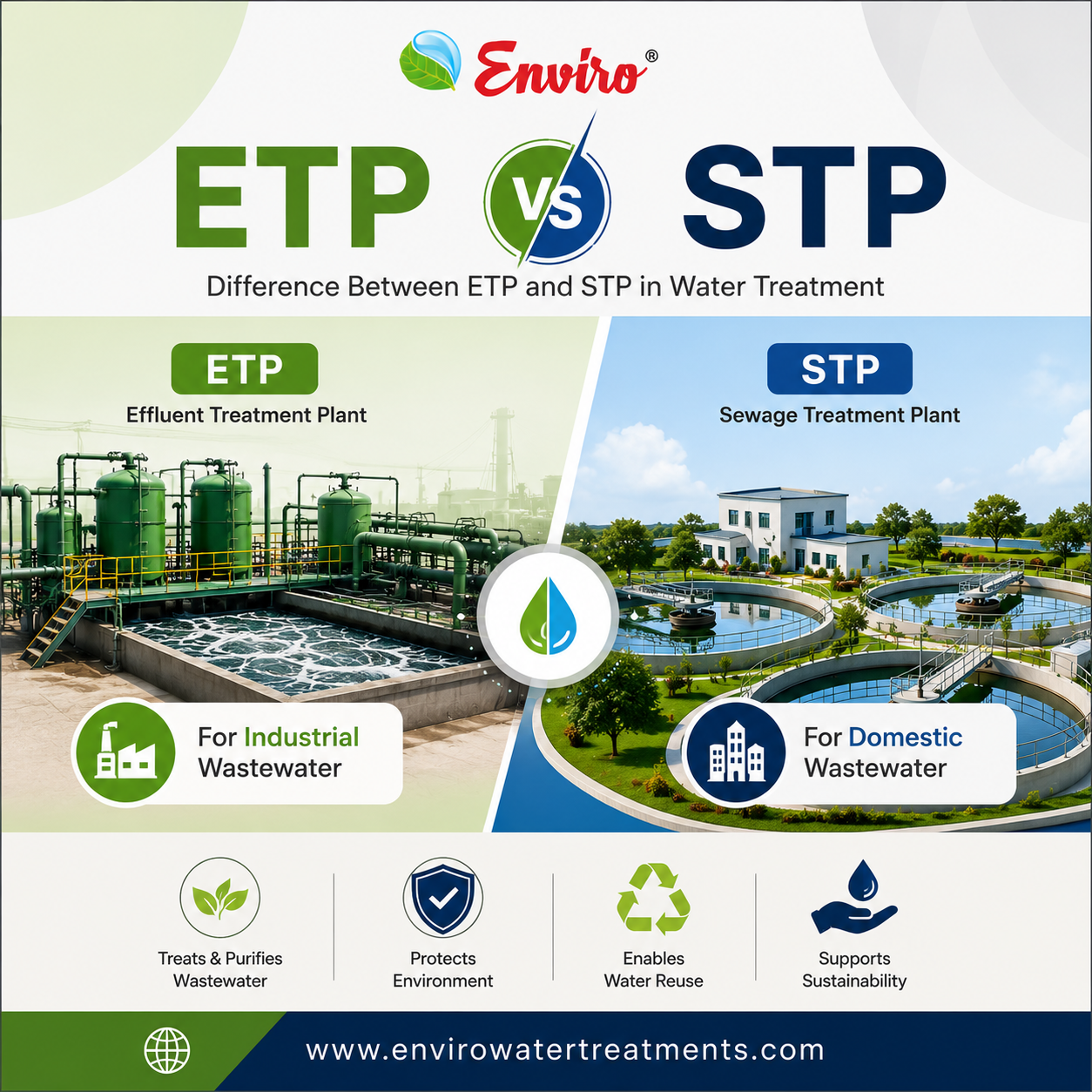
Difference Between ETP and STP in Water Treatment
Learn the key differences between ETP and STP systems, their working process, applications, benefits, and importance in wastewater treatment.
Wastewater treatment is essential for protecting the environment, conserving water, and maintaining public health. Industries, commercial buildings, apartments, and municipalities generate different types of wastewater that must be treated before discharge or reuse.
Two commonly used treatment systems are:
- ETP (Effluent Treatment Plant)
- STP (Sewage Treatment Plant)
Although both systems treat wastewater, they are designed for different purposes and handle different types of contaminants.
Understanding the difference between ETP and STP helps in selecting the right treatment system for industrial and domestic applications.
What is ETP?
ETP stands for Effluent Treatment Plant.
An ETP is used to treat industrial wastewater containing chemicals, oils, toxic substances, heavy metals, and industrial pollutants.
Industries generate wastewater during manufacturing and processing activities. ETP systems remove harmful contaminants before water is discharged or reused.
What is STP?
STP stands for Sewage Treatment Plant.
An STP is designed to treat domestic sewage or wastewater generated from:
- Homes
- Apartments
- Hotels
- Hospitals
- Commercial buildings
Sewage water mainly contains organic waste, soap water, kitchen waste, and human waste.
STP systems treat sewage water biologically to make it safe for disposal or reuse.
Difference Between ETP and STP
1. Type of Wastewater Treated
ETP
Treats industrial wastewater containing:
- Chemicals
- Oils
- Toxic pollutants
- Heavy metals
STP
Treats domestic sewage containing:
- Organic waste
- Bathroom water
- Kitchen wastewater
- Human waste
2. Source of Wastewater
ETP
Used in:
- Industries
- Factories
- Manufacturing units
- Chemical plants
STP
Used in:
- Apartments
- Residential buildings
- Hotels
- Hospitals
- Commercial complexes
3. Treatment Process
ETP Process
ETP uses:
- Physical treatment
- Chemical treatment
- Biological treatment
Chemical dosing is commonly used in ETP systems.
STP Process
STP mainly uses:
- Biological treatment
- Aeration process
- Microorganisms to break down organic matter
4. Complexity of Treatment
ETP
More complex because industrial wastewater contains hazardous pollutants.
STP
Less complex compared to ETP because sewage mainly contains biodegradable waste.
5. Operating Cost
ETP
Higher operating and maintenance cost due to chemical treatment and complex processes.
STP
Lower operating cost compared to ETP.
6. Purpose of Treatment
ETP
Protects the environment from industrial pollution.
STP
Maintains sanitation and public health.
ETP Working Process
The ETP process generally includes:
Preliminary Treatment
Removes large particles and oil.
Primary Treatment
Chemical treatment and sedimentation.
Secondary Treatment
Biological treatment to reduce pollutants.
Tertiary Treatment
Filtration and disinfection for improved water quality.
STP Working Process
The STP process generally includes:
Screening
Removes large solids.
Aeration
Microorganisms break down organic matter.
Sedimentation
Settles sludge and suspended solids.
Filtration and Disinfection
Improves treated water quality.
Applications of ETP
- Chemical industries
- Pharmaceutical industries
- Textile industries
- Food processing industries
- Manufacturing plants
Applications of STP
- Apartments
- Hotels
- Hospitals
- Commercial buildings
- Residential communities
Benefits of ETP
- Removes industrial pollutants
- Protects natural water bodies
- Ensures pollution control compliance
- Supports industrial water reuse
Benefits of STP
- Improves sanitation
- Reduces water pollution
- Supports water recycling
- Environment-friendly wastewater treatment
Can Treated Water Be Reused?
Yes. Both ETP and STP treated water can be reused depending on treatment quality.
Common reuse applications:
- Gardening
- Cooling towers
- Flushing systems
- Industrial processes
Importance of Wastewater Treatment
Proper wastewater treatment helps:
- Prevent environmental pollution
- Conserve water resources
- Reduce health risks
- Improve sustainability
- Meet government regulations
Which System Do You Need?
Choose ETP If:
You generate industrial wastewater with chemicals and pollutants.
Choose STP If:
You need treatment for domestic sewage or residential wastewater.
Conclusion
ETP and STP are both important wastewater treatment systems, but they serve different purposes. ETP is used for industrial wastewater treatment, while STP is used for domestic sewage treatment.
Choosing the right treatment system depends on the type of wastewater generated and treatment requirements.
Proper wastewater treatment not only protects the environment but also supports sustainable water management and reuse.
Looking for ETP or STP solutions for your industry or building?
Call Now: +91 9945125656
Get expert consultation and customized water treatment solutions.