Choosing a booster pump is no longer simply a question of motor power or brand name. For buildings with variable water demand, the control system, motor efficiency, pressure stability, operating cost, and service requirements can matter just as much as the pump hydraulics.
This comparison looks at Mkawa Intelligent VFD Booster Pumps, Grundfos CM/Hydro MPC-type systems, Wilo booster systems, and Lubi/Kirloskar pressure-boosting solutions, with an important caveat: the exact result depends on the model, duty point, installation and control configuration.
At a glance
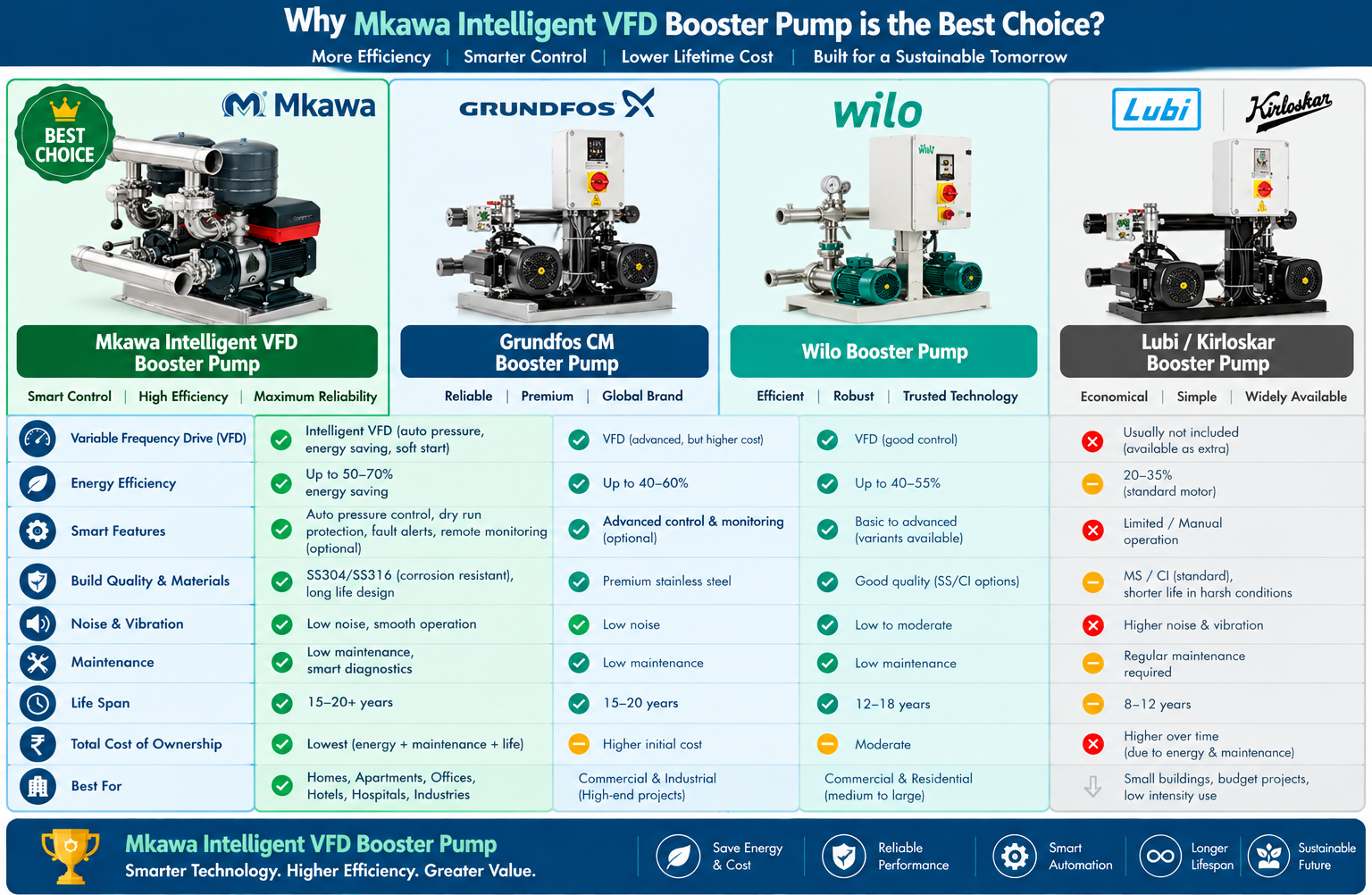
| Feature | Mkawa Intelligent VFD | Grundfos CM / Hydro MPC | Wilo Booster | Lubi / Kirloskar |
| Variable-speed control | Yes | Yes, depending on system | Yes, depending on model/system | Model dependent |
| Constant-pressure control | Yes | Yes | Yes | Available on selected systems |
| Permanent-magnet motor | Selected Mkawa models | Depends on selected model | Depends on selected model | Model dependent |
| Smart pressure response | Integrated on selected Mkawa models | Advanced system controls | Advanced controls on selected systems | Varies by product |
| Energy optimisation | Designed for variable demand | Strong VFD-based optimisation | Strong on variable-speed systems | Depends on configuration |
| Twin/multi-pump options | Available | Available | Available | Available |
| Typical positioning | Residential → commercial | Commercial → industrial | Residential → commercial → industrial | Residential → commercial |
| Main selection factor | Duty point + control + motor technology | System configuration | System configuration | Model/configuration |
1. Mkawa: intelligent VFD + permanent-magnet technology
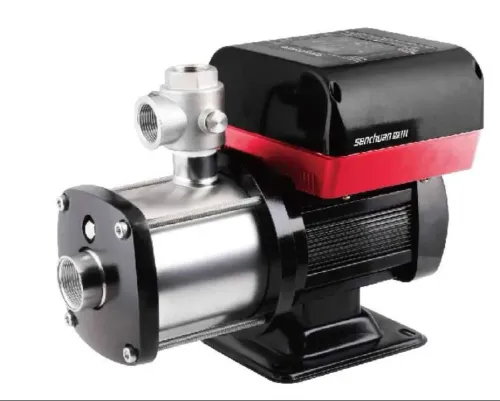
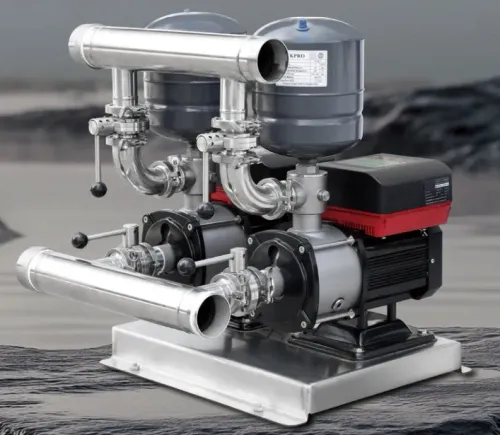
Mkawa's current BHM booster range combines VFD intelligent pressure control with permanent-magnet IE5-class motors on the listed models. For example, the BHM8-55SET and BHM12-55SET are twin-pump systems intended for higher-demand domestic and commercial applications.
The practical advantage of this architecture is that pump speed can respond to changing demand rather than simply running at one fixed speed.
When demand falls, the controller can reduce speed; when several outlets open, it can increase speed toward the required pressure setpoint. Mkawa describes this as intelligent pressure control, while also cautioning that actual energy consumption depends on the hydraulic duty and installation.
Mkawa's WHB/WHBJL range similarly uses VFD pressure control and a permanent-magnet platform, with the company quoting up to 40% energy-saving effect as a brochure claim. That figure should be treated as model/application dependent rather than a guaranteed saving.
2. Grundfos: mature VFD booster-system architecture
Grundfos has a well-established approach to pressure boosting. Its Hydro MPC systems can use multiple electronically speed-controlled pumps, with configurations ranging from two to six pumps and application-optimised control software.
Grundfos also explicitly explains the basic VFD benefit: variable-speed systems can adjust output to the required water demand, potentially reducing energy consumption and pressure losses compared with inappropriate fixed-speed operation.
The important point is that Grundfos should not be treated as a simple fixed-speed competitor to Mkawa. A properly configured Grundfos booster system can also provide sophisticated variable-speed control.
The more meaningful comparison is therefore:
Mkawa's integrated intelligent VFD + PM motor architecture vs. the specific Grundfos system configuration being quoted.
3. Wilo: strong multistage and booster-system technology
Wilo offers both conventional multistage pumps and complete booster systems.
For example, Wilo's Comfort COR-3 Helix V system uses multiple stainless-steel pumps and is configured for automatic pressure-boosting applications.
Wilo also offers electronically controlled Helix VE models. One documented Helix VE model uses an IE4 motor, soft start and variable-speed operation, demonstrating that Wilo also has high-efficiency variable-speed technology in its portfolio.
Therefore, the comparison should again be made against the exact Wilo model and control package, rather than treating every Wilo booster as having identical technology.
4. Lubi / Kirloskar: practical pressure-boosting solutions
Kirloskar's K-Booster is positioned as a compact residential pressure-boosting system for applications such as bungalows, villas and small housing societies.
The manufacturer's documentation describes automatic operation based on pressure, together with features such as a Y-strainer, compact construction and thermal overload protection.
Kirloskar also sells a broader range of pressure-boosting products, so the technology level varies by model.
This makes Lubi/Kirloskar particularly relevant when application simplicity, conventional pressure boosting and purchase economics are the main considerations.
Where Mkawa can differentiate
The strongest technical case for Mkawa is not simply that it is a "better brand." It is the combination of several technologies in selected models:
Intelligent VFD control
The pump can vary motor speed according to pressure demand rather than operating continuously at maximum speed.
Permanent-magnet motor technology
Selected Mkawa BHM models use permanent-magnet IE5-class motors.
Constant-pressure operation
The control system is designed to respond to changing demand and maintain the selected pressure target.
Energy-conscious operation
VFD control is particularly useful when demand varies substantially throughout the day. However, energy savings should always be calculated using the actual duty cycle, flow, head, tariff and operating hours.
Twin-pump configuration
Mkawa offers twin-pump booster sets, including the BHM4-20SET/BHM5-40SET and larger BHM8-55SET/BHM12-55SET families.
Compact intelligent-system approach
Instead of evaluating the motor, VFD, pressure sensor and pump as unrelated components, the selected Mkawa systems are designed as integrated pressure-control packages.