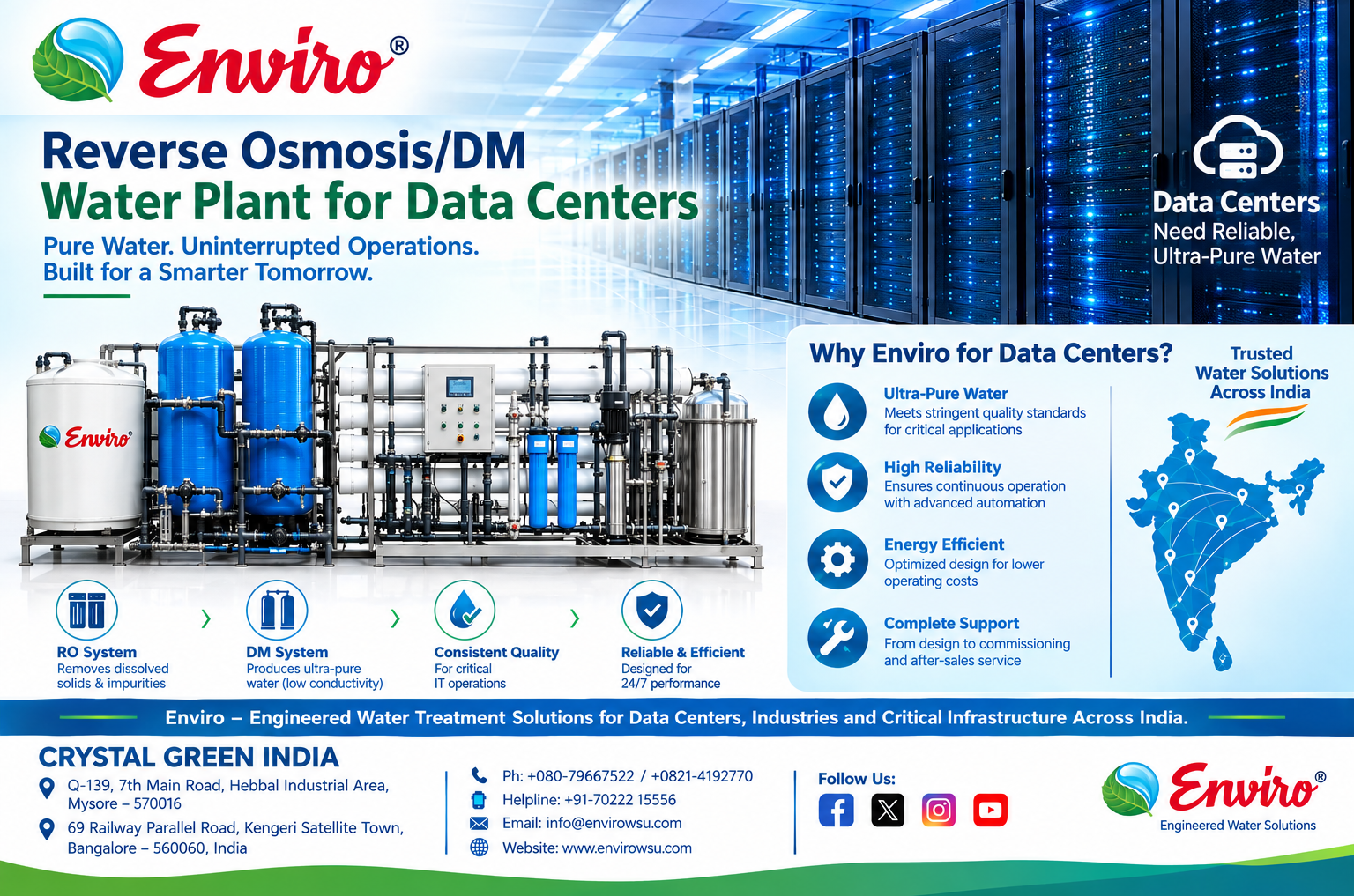
Enviro – Engineered Water Treatment Solutions for Data Centers, Industries and Critical Infrastructure Across India.
RO Recovery and Reject Water Management
RO does not convert all feed water into permeate.
A portion of the feed becomes RO reject or concentrate.
Therefore, an industrial RO plant should be designed with an appropriate water balance.
For example:
Feed Water → RO System → Permeate + Reject
The recovery percentage depends on:
Feed-water chemistry
Membrane configuration
Scaling potential
Required permeate quality
Pretreatment
Number of stages
Operating conditions
Reject-water management is an important consideration for large data centers because water consumption and sustainability are increasingly important facility-management objectives.
Where technically and legally appropriate, RO reject can potentially be considered for suitable non-critical applications after evaluating its water quality.
Pretreatment Is Critical for RO Performance
A common mistake is to focus only on the RO membrane.
The performance and service life of an RO system depend heavily on pretreatment.
Depending on the feed water, pretreatment may include:
Raw Water Tank → Pressure Sand Filter → Activated Carbon Filter → Softener / Antiscalant → Micron Filter → RO
Additional treatment may be required for specific contaminants.
For example, groundwater containing significant iron or manganese may require dedicated removal before the RO system.
Likewise, high turbidity or high SDI may require enhanced pretreatment.
DM Plant After RO
Using RO as pretreatment for DM can reduce the ionic load entering the ion-exchange system.
This can provide operational benefits such as reduced regeneration demand and improved resin utilization, depending on the application.
A typical arrangement can be:
RO Permeate → Cation Unit → Degasser → Anion Unit → Mixed Bed → DM Water Tank
The exact arrangement depends on the required conductivity, silica specification and water chemistry.
For applications requiring very high-purity water, additional polishing technologies may be considered.
Instrumentation and Automation
Modern data centers require predictable and continuously monitored utility systems.
An Enviro RO/DM plant can be configured with instrumentation such as:
Feed pressure monitoring
RO pressure monitoring
Permeate flow meter
Reject flow meter
Feed conductivity
RO permeate conductivity
DM conductivity
pH monitoring
Tank level sensors
Pressure switches
Flow switches
Low-pressure protection
High-pressure protection
Automatic valves
PLC control
HMI interface
The level of automation can be selected according to project requirements.
For critical facilities, alarm and interlock logic can be integrated into the plant-control philosophy.
Online Conductivity Monitoring
Conductivity is an important parameter for RO and DM systems.
RO permeate conductivity can provide an indication of membrane performance.
DM-system conductivity monitoring can help operators identify resin exhaustion or changes in treated-water quality.
For a data-center application, online monitoring can therefore provide an additional layer of operational control.
Duplex and Standby Philosophy
Data centers place significant emphasis on continuity.
For critical utility systems, the water-treatment plant may be designed with suitable standby arrangements.
Depending on the project, this can include:
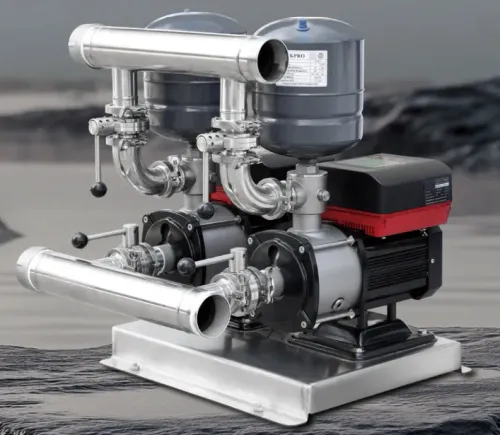
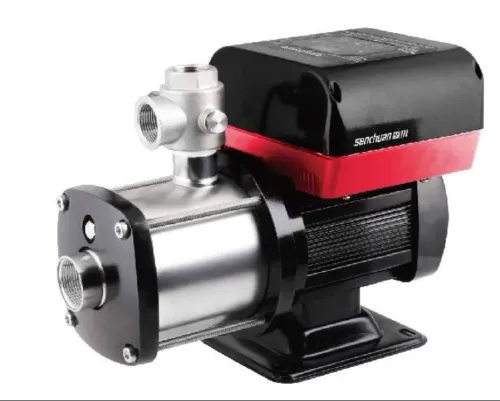
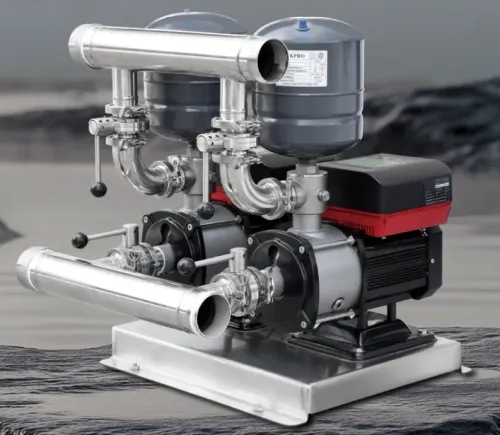
Duty/standby feed pumps
Duty/standby high-pressure pumps
Multiple RO trains
Standby dosing systems
Redundant critical instruments
Separate treated-water storage
Automatic changeover
Parallel treatment trains
The appropriate redundancy philosophy should be determined during project engineering.
A larger data center may benefit from multiple treatment trains instead of relying on a single large RO train.