Water may look clean to the eye, but that does not always mean it is free from unwanted impurities.
Depending on the source, water can contain suspended particles, colloids, bacteria, microorganisms and other contaminants that can affect its quality and create problems for further treatment.
This is one of the reasons Ultra Filtration (UF) has become an important technology in modern water-treatment systems.
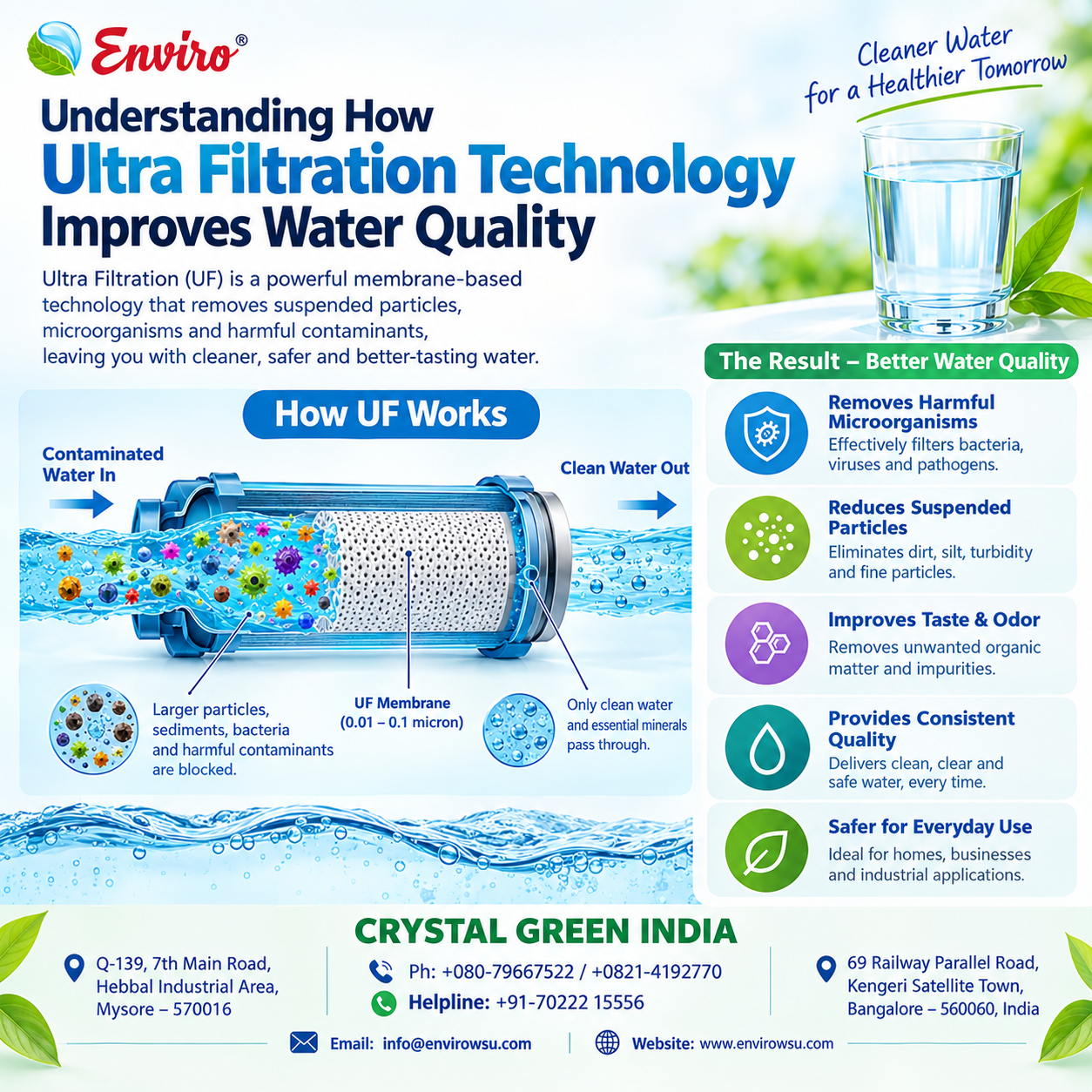
UF is a membrane-based filtration process that uses very fine pores to separate contaminants from water.
It is commonly used in industrial water treatment, drinking-water applications, wastewater reuse and, particularly, as a pre-treatment system before Reverse Osmosis (RO).
What Exactly Is Ultra Filtration?
Ultra Filtration is a pressure-driven membrane process.
In simple terms, water is pushed through a membrane with extremely small pores. Water and smaller dissolved substances can pass through, while larger particles and microorganisms are retained.
Think of the UF membrane as a very fine physical barrier. Instead of relying mainly on chemicals to separate contaminants, the system uses the membrane itself to perform the filtration.
This makes UF useful when conventional filtration alone cannot provide the required level of water clarity.
How Does a UF Plant Work?
The working principle of a UF plant is relatively simple, although the complete system can include several stages depending on the quality of the raw water.
A typical process looks like this:
Raw Water → Pre-Treatment → UF Membrane → Treated Water → Further Treatment / Application
Before water reaches the UF membrane, suitable pre-treatment may be required to remove larger particles and protect the membrane.
The pre-treated water is then passed through the UF membrane under pressure. The membrane retains suspended solids, colloids and many microorganisms, while the filtered water passes through.
Over time, material can accumulate on the membrane surface. For this reason, UF systems are normally designed with cleaning and backwashing arrangements to maintain performance.
What Can Ultra Filtration Remove?
UF is particularly effective for contaminants that are larger than the membrane's separation range.
Depending on the membrane and system design, UF can remove or significantly reduce:
• Suspended solids
• Fine particles
• Colloids
• Turbidity
• Bacteria
• Many microorganisms
• Certain larger organic compounds
One important point is that UF does not remove all dissolved substances.
For example, dissolved salts are generally too small to be retained by a conventional UF membrane. If the objective is to reduce TDS or dissolved salts, technologies such as Reverse Osmosis (RO) may be required.
Where Is Ultra Filtration Used?
UF is not limited to one particular industry. Its applications range from relatively small commercial systems to large industrial treatment plants.
• Industrial Water Treatment:
Many industries require water with consistent quality for manufacturing and process applications. UF can be incorporated into these treatment systems to reduce suspended solids and microbial contaminants.
• Drinking Water Treatment
UF can be used for treating water from sources where turbidity, suspended particles and microorganisms are a concern.
• Wastewater Treatment and Reuse
Water reuse is becoming increasingly important as industries look for ways to reduce freshwater consumption.
UF can form part of a wastewater-recovery system after suitable primary or biological treatment. The UF stage can provide additional filtration before the water is reused or sent to another treatment process.
• RO Pre-Treatment
UF is widely considered for applications where the RO system requires better-quality feed water.
• Commercial Applications
Hotels, hospitals, residential communities, educational institutions, food-processing units and other commercial facilities may use UF as part of their overall water-treatment setup.
Looking for an Ultra Filtration Plant?
If you are planning to install an Ultra Filtration Plant, start with a proper raw-water analysis and discuss your flow rate and application requirements with a water-treatment professional.
Crystal Green India Enviro can help evaluate your requirement and identify a suitable water-treatment approach based on your application.
Better filtration starts with the right treatment design.