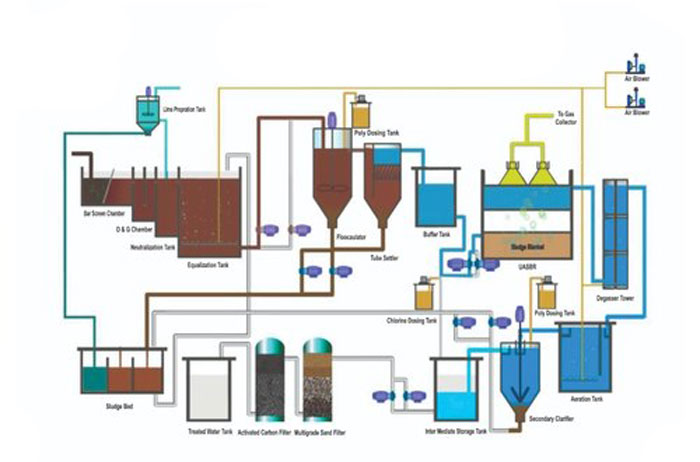
What is the process of the ETP Plant?
The treatment process of the Effluent Treatment Plant includes the removal of suspended particles, dissolved organic matter, and the handling of sludge for disposal. Different processes involved are -
- Equalization- The equalization tank balances the raw effluent from various processing units. An existing mixed effluent tank collects wastewater and pumped to an existing aeration tank, which also functions as an equalization tank. The floating aerator is provided to homogenize the effluent before it is pumped to the neutralization tank for treatment.
- pH Control - The pH value of effluent should be between 5.5 and 9.0, according to the Bureau of Indian Standards (BIS) .PH neutralization is used to modify the pH of the wastewater. For waste that is acidic bases are used to modify the pH of a solution. In the case of alkali waste acids are used to modify the pH of a solution.
- Coagulation - Coagulation is a technique in which liquid aluminum sulphate is added to untreated water which causes tiny dirt particles to stick together after mixing. That collection of particles combines to generate larger, heavier particles which can be easily removed through settling and filtration.
- Sedimentation - Water travels slowly in this process, causing the heavy particles to settle at the bottom. The particles that gather at the bottom of a container are called Sludge.
- Filtration - Filtration is the process in which the water passes through a filter that removes particulates. The filters are made out of sand and gravel layers. Backwashing is required to clean these filters on a regular basis.
- Disinfection - Before entering the distribution system, water is disinfected. To disinfect and decontaminate water, chlorine is used.