Learn how a DM water plant works, its process, uses, and benefits. Discover why demineralized water is essential for industrial applications and equipment protection.
Water plays a critical role in industrial operations, but not all water is suitable for high-precision applications. Minerals, salts, and impurities present in raw water can damage equipment and affect product quality. This is where a DM (Demineralization) Water Plant becomes essential.
A DM Water Plant removes dissolved solids and minerals from water, producing highly purified water suitable for industrial and commercial use.
What is a DM Water Plant?
A DM Water Plant (Demineralization Plant) is a water treatment system that removes dissolved salts and minerals such as calcium, magnesium, sodium, chlorides, sulfates, and other ions through the ion-exchange process.
The output water is called demineralized water, which has very low conductivity and is free from mineral impurities.
Why is DM Water Required?
Demineralized water is essential in applications where mineral-free water is required.
Reasons include:
- Prevents scaling in boilers and pipelines
- Avoids corrosion in equipment
- Improves efficiency of industrial systems
- Ensures product quality in manufacturing
DM Water Plant Process
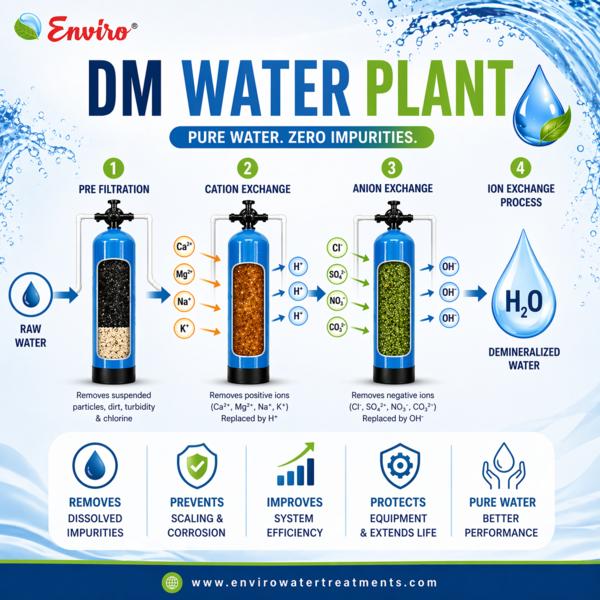
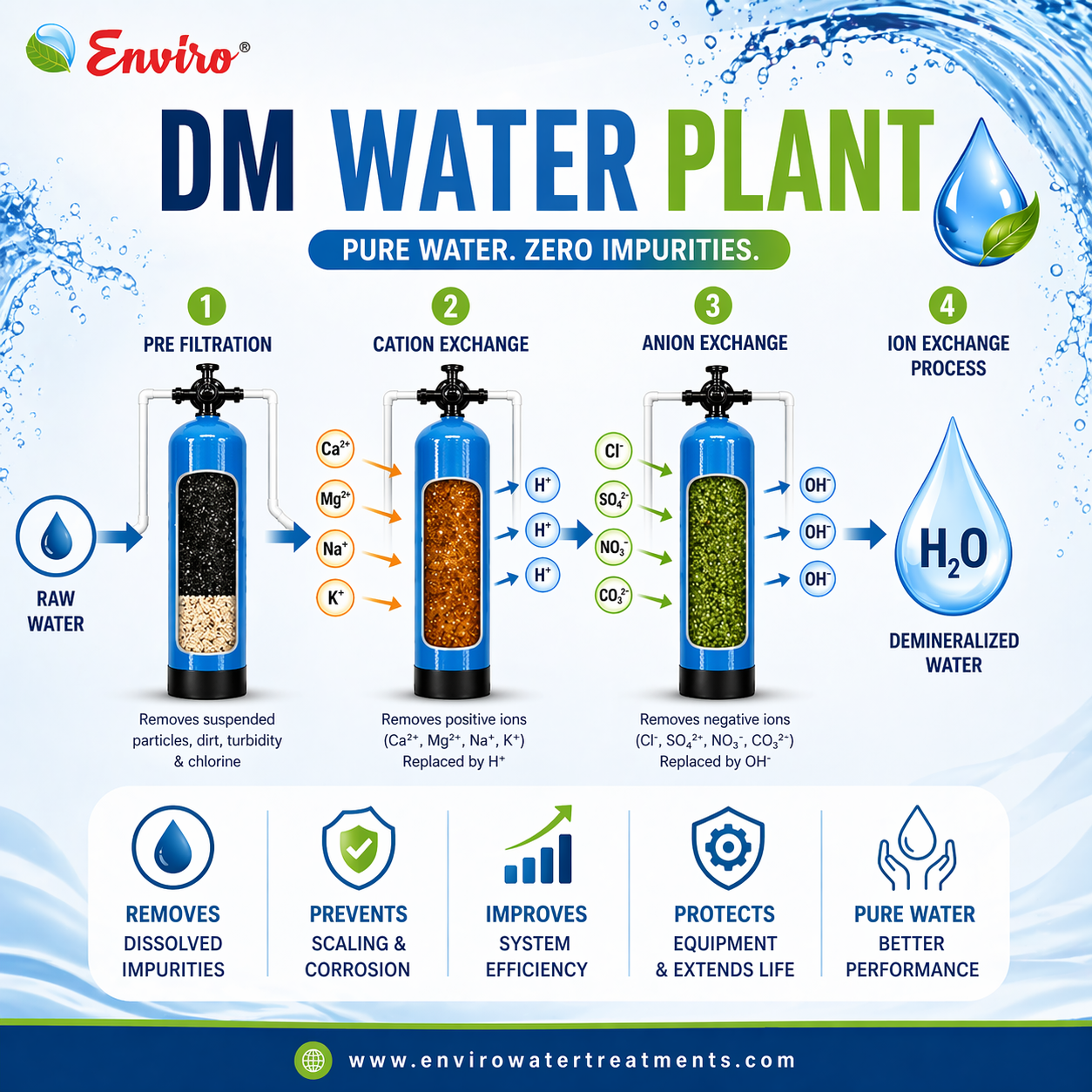
The DM plant works on the ion exchange process using special resins.
1. Pre-Treatment
Raw water first passes through:
- Pressure Sand Filter (removes suspended particles)
- Activated Carbon Filter (removes chlorine and organic impurities)
2. Cation Exchange Process
Water passes through a cation resin, which removes positively charged ions like:
- Calcium (Ca²⁺)
- Magnesium (Mg²⁺)
- Sodium (Na⁺)
These ions are replaced with hydrogen ions (H⁺).
3. Anion Exchange Process
Water then passes through an anion resin, which removes negatively charged ions like:
- Chlorides (Cl⁻)
- Sulfates (SO₄²⁻)
These are replaced with hydroxide ions (OH⁻).
4. Formation of Pure Water
Hydrogen (H⁺) and hydroxide (OH⁻) combine to form pure water (H₂O).
5. Mixed Bed Polishing (Optional)
A mixed bed unit further refines the water to achieve ultra-low conductivity.
Types of DM Water Plants
- Two Bed DM Plant (Cation + Anion)
- Mixed Bed DM Plant
Applications of DM Water
DM water is widely used in various industries:
- Power plants – Boiler feed water
- Pharmaceutical industry – Drug formulation
- Chemical industry – Process water
- Food and beverage industry – Ingredient water
- Electronics industry – Circuit manufacturing
- Laboratories – Testing and research
Benefits of DM Water Plant
- Removes up to 99% of dissolved impurities
- Improves equipment life
- Reduces scaling and corrosion
- Ensures consistent product quality
- Low maintenance and operational cost
- Environmentally friendly process
DM Water vs RO Water
| Feature | DM Water | RO Water |
|---|---|---|
| Purity Level | Very High | Moderate |
| Mineral Removal | Almost 100% | 90–95% |
| Conductivity | Very Low | Low |
| Usage | Industrial | Drinking & General Use |
DM water is more pure than RO water.
Maintenance of DM Water Plant
- Regular regeneration of resins
- Monitoring conductivity levels
- Periodic system cleaning
- Proper pre-treatment maintenance
Conclusion
A DM Water Plant is essential for industries requiring high-purity water. By removing dissolved salts and minerals, it ensures efficient operation, protects equipment, and improves overall performance.
Investing in a DM plant is a long-term solution for reliable and high-quality water treatment.
Call to Action
Looking for a DM Water Plant for your industry?
Call Now: +91 9945125656
Get expert consultation and customized water treatment solutions.